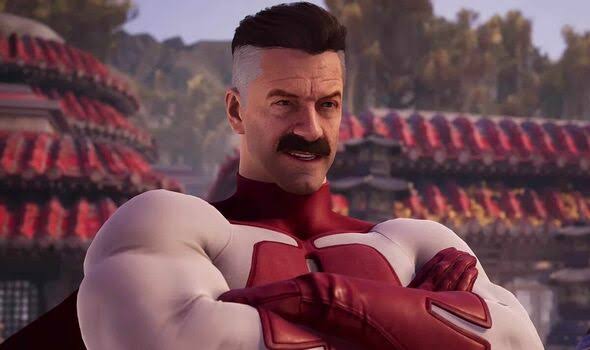
Omni-man floats just above the stage, like a malevolent god. He teleports behind me and starts pummelling me into the dirt, with a combo string the likes of which my feeble brain will likely never fully comprehend. I watch helplessly as my health drains from full to almost nothing, trying my best to escape his grip. When I do finally escape his flurry of fists, it happens again. Omni-man’s Fatality animation plays out, I am all too familiar with it.
Every fight with Omni-man has the exact same result. Me getting the shit kicked out of me faster than my thumbs can react. It doesn’t matter who controls him, whenever he appears in online matchmaking, I know I’m not even going to get a hit in before meeting my maker.
Until, one day, not so long ago, after over a fortnight of practicing the basics of Mortal Kombat 1, something clicked.
Time appeared to slow.
Rather than rush in, desperate to land at least one hit, I centered myself, awaiting his approach. I took note of how his combo started. He rises off the ground, teleports behind me, and hits me, with what in Fighting Game terms is called a MID. The Combo ends, and he rises ready to repeat his combo except this time…
…I blocked it.
I didn’t expect it, and neither did Omni-man. I landed a few simple hits, a basic combo before he escaped from my reach. He rose above the stage yet again ready to end me. But I could see the matrix now, I could predict his next move, I blocked him every time, I didn’t let him do another combo, and without it, he had no idea what to do.
I’d bait him into attempting it again. Taking a step forward as though I was going to attack and leave myself open. He’d teleport, only to find that I wasn’t vulnerable, I was ready for him. We rematched over, and over again with the exact same result. Me winning. I hadn’t beaten him through memorizing a long combo or being skilled with the inputs and timing. I beat him because I outsmarted him.
I wasn’t a pro player, far from it, I wasn’t even that good. But I’d overcome one of the biggest challenges in fighting games that I’d faced so far. And goddamn did it feel good.
This is not a review of Mortal Kombat 1, instead, it is much more of a “noobs journey”, a sort of step-by-step of how I learned to finally understand Fighting Games.
Throughout 2023 I got lost in a myriad of single-player titles from some of my all-time favourite developers, a storm was brewing just outside of my view, and an entire world of video games that I had only ever glimpsed from afar was about to release a hat trick.
The Fighting Game Community was awaiting the release of three major new games, from some of the genre’s biggest and most influential franchises of all time, all within an 8-month window of each other.
I could feel the excitement from those in the know. The sense that these three games were going to somehow build on and improve upon their shared legacies to create something truly special. Legacies that I had absolutely no experience in, despite trying my best to stay as informed as possible with everything Video Games.
The idea that there was an entire genre of video games that I had never touched, just waiting for me. A genre unlike any other that I had experienced, with a strong community and history, was all too alluring and at the same time incredibly intimidating. I knew enough to know that Fighting Games were hard to get into, they were like an entirely new language when compared to anything I had ever played before.
I’ve always considered learning video games in general, as something akin to learning another language. For those of us who started early, it’s easy, we learned by osmosis. Our spongy baby brains simply picked it up over time. There is a shared common tongue used across most video games that helps you from game to game. Learning to navigate a 3D world in Mario 64 helped you pick up and understand pretty much every 3D game that followed it. Even playing a first-person shooter for the first time wasn’t too hard to understand after having slowly learned how to manipulate an in-game camera in the various games before it. It wasn’t like having to learn an entirely new language; it was more like learning a new accent.
Fighting Games, however, require you to learn a completely different video game language. A language that until recently I have never properly attempted to learn.
Here’s a brief rundown of my history with Fighting Games, my noob cred.
I fought a kangaroo on a Tekken arcade cabinet at my local fish and chip shop (There’s a strong possibility that I just waggled the stick while a promo animation played).
I played Killer Instinct on the Xbox VCR-looking console (I don’t think I even looked at or knew that there was a moves list to check and learn).
I put 80 hours into the single-player of Super Smash Brothers Ultimate only to find out that there are buttons for block, evade, and grab that I somehow never used.
I put a weekend into Dragon Ball FighterZ and couldn’t get passed the tutorial.
So, despite my aging brain, I’m ready to finally put the work in and learn the language of fighting games to see exactly what it is that I’ve been missing all this time.
Starting with Mortal Kombat 1.
I picked MK1 because it looks stunning. Its aesthetic is a pleasing mix of old school martial arts films and 80’s action movies, with a little bit of B-grade horror thrown in for good measure.
The ‘one’ in the title helped a lot, implying a reset of the franchise’s dense lore, and I’ve heard that the developers NetherRealm Studios make engaging and well-told stories. So, the game’s single-player offerings should tide me over should I never reach the heights of online play.
Then there are Mortal Kombat’s famously cool and weird guest character rosters, this time promising a bunch of TV’s best revisionist superheroes, Homelander from The Boys, Omni-man from Invincible, and my personal favourite, Peacemaker from… Peacemaker. I can’t wait to see if he has his iconic dance sequence in there somewhere when he eventually releases.
All of this, and the game was only a month old. Meaning that there is still some hope that there are other noobs playing online that I might stand a chance against.
My first and most immediate hurdle with Mortal Kombat is the controls, again fighting games are essentially a different language.
For example, a near-universal constant across almost all video games is that the ‘A’ button is jump. But in fighting games, the jump button is up on the d-pad.
Now, the thumbstick, which has for decades been the “move” around the screen toggle, for almost every game in existence since it was invented, supposedly isn’t the best tool for the job here. Instead, it’s yet again, the D-Pad. The D-pad is typically relegated in other games to quick-swapping weapons when you remember that it even exists. There are probably more games in existence where the D-pad literally does nothing, than games that use it.
The controller, which was once an extension of my hand, is suddenly a foreign object to me. It is now a barrier preventing me from finally being able to enjoy a video game.
This reminded me of my failed attempt at learning Dragon Ball Fighterz, over, and over again, I’d try to get my thumbs to do the inputs that were on the screen before me. But I couldn’t. It was deflating. The simple combination of buttons in front of me seemed impossible.
Worse even when I could pull it off, the idea of ever being able to do it again, let alone do it consistently enough to use it in a match seemed nigh impossible. If I couldn’t even pass the tutorial what hope did I have to play online?
I turned to the place where all dumbfounded gamers go when they can’t do something, YouTube. What I found were hour-long Videos, that while in English, may as well not have been. Face buttons that were numbered for some reason, and directions on the D-Pad weren’t referred to as left and right, they were forward and back. Terms like spacing, whiffing, and recovery were thrown at me with reckless abandon. Even scrubbing back and forth through the video I couldn’t make any sense of it.
Then they mentioned “Frame times”. Which essentially cooked the last brain cell I had left that was ready to learn something new. If I had to learn the details of this game down to the individual frames, then I would never understand this. I will never be able to play a Fighting Game.
A quick note here to clarify things, so as not to put anyone off. I knew what frames meant in a more general sense. But I completely misunderstood what they meant by it here. When I heard pro-fighting gamers talk about ‘frame timing’ I thought it meant that you had to perfectly time button presses to land on exact frames. Like somehow, I thought these motherfuckers could see a single frame, that is 1/60th of a second, and then react to that within that fraction of a second.
Frame time instead is just a way to measure how long it takes in the game to do something. It’s essentially a way to say, “Hey this move is slow so you can counter it with something else that’s faster” It lets you measure how fast or slow a move actually is since everything in a fighting game happens too fast for you to measure it in seconds, they use frame times. You could technically break it up into fastest, fast, quick, medium, etc and it would pretty much still serve the same purpose. It’s just easier and more accurate to say, “This move takes 19 frames to complete so a 7-frame punch is going beat it by land first.”
I was so disheartened by this misunderstanding of what it took to learn fighting, that I gave up. But not this time, this time things will be different. I decided to dive into the MK1’s campaign to see if it helped. And thank God I did because it hooked me immediately.
The story surprised the hell out of me, it had a sense of earnestness and realism to the characters and world throughout that I just wasn’t expecting. The performances were some of the best I’ve seen in a video game, and made me fall in love with the entire cast, even Johnny Cage who I assumed I would hate. This gave me the juice I needed to learn this game. I wanted to spend more time in its world.
MK1’s tutorial surprisingly, wasn’t as overwhelming as the one in Dragon Ball Fighterz. Partly because I thought I’d completed it when in reality I had only beaten the basics section of it… I think this genuinely helped me stay on board long enough to realize that Fighting Game tutorials are much more of a place to return to throughout your journey, than something that you need to complete before even starting. In fact, a lot of tutorials are for much more advanced techniques to use much later in your journey once you’ve got a solid grip on the basics.
After leaving the tutorial I had a breakthrough, I found two things that would ultimately lead me to break the barrier that prevented me from learning Fighting Games.
One – I found the actual moves list. I know this is insane, but until this point, I had only referred to a small list of moves from the pause menu. I hadn’t realized that I could then open yet another window that included a full list of all the moves that I could learn, including fatalities which I guess I just assumed people found out by trial and error or something.
After checking this out with a few characters I could see that most of the moves and super moves between the roster shared similar d-pad inputs to each other. This was huge for me because it meant that once I had a grip on how to input the directional buttons properly for one character, I’d be able to learn them all.
Two – Someone online said that combos don’t matter that much and that the combo tutorials are bad for new players because they put them off learning the actual game…. wait… What?
That’s right. Combos and combo strings/combo chains aren’t that important. You can counter them and block them. Combos aren’t “the game” like I’d thought, they’re just part of it. Learning a combo is just a way to make the most out of an opportunity to do damage when the opportunity arises. The real game is in being able to find those opportunities in the first place.
My thought process around fighting games at this point was completely flipped upside down. If it’s not about memorizing long strings of inputs, and is instead more about using mind games, recognizing people’s patterns, and predicting people’s moves, then maybe, just maybe I can do this.
So, how do I approach learning these mind games? Well, first off everything in a fighting game has a counter. If I learn them, then I can stop my opponent from smacking me around. To put it simply, attacks can be countered with a block, blocks can be countered with a grab, and grabs can be countered with a punch or a kick.
It gets deeper than that, blocking while standing can be countered with a low attack. Low attacks can be countered with a low block. Low blocks can be countered with an overhead attack or a jump. It’s like paper scissors rock. Or to compare it to a video game that everyone’s played… It’s like player vs player Pokémon.
Hear me out.
Playing against a real player in a Pokémon match is all about predicting their next move, and even predicting what they’re likely predicting that you will do. There are layers to this mind game.
If they have a fire-type Pokémon on the field, and you have a water-type Pokémon, there’s a good chance that they’re going to swap out that fire-type Pokémon on their next move, because it’s vulnerable to your water-based attacks. So, they’ll probably send out a grass or electric type next. So, if you predict this swap you can use a move that would be more effective against the Pokémon that they’re going to swap into rather than the one that’s already on the field. That kind of thinking is how you get ahead in a Pokémon match, it is also what gets you ahead in a fighting game.
When you block your opponent’s attack in MK1, they are likely to try and block straight after they’ve realized they can’t get hit you, because they expect that you will return the favour and follow up with a quick punch.
But if you’ve predicted that they’ll block after their attack has ended, then you can use a grab them instead and throw them to the ground where they belong.
Next time you block one of their attacks they’ll probably anticipate you following that up with a grab like you did before, so they will try to get out of the incoming grab with a quick punch. If you’re anticipating this, you can shake it up, duck underneath their punch, and follow it up with an uppercut. You can win a whole God damn game like this, without having to know a single combo. They can’t combo you if they can’t even hit you.
Invigorated by my newfound knowledge, I started practicing my moves and specials. I learned how to move my thumb across the D-Pad to pull off moves that once seemed impossible. Now that I was somewhat familiar with my character’s move-set I looked into how the hell you pull off a combo, and I had yet another, revelation.
Combos aren’t a random string of hard-to-remember inputs, as I had naively thought, they are just a few basic moves and specials strung together to form the beloved combo.
Combos suddenly felt obtainable, now no longer out of my reach. If I learned how to pull off each individual move consistently, I would eventually be able to pull off a combo.
But as it turns out I couldn’t pull off my character’s moves consistently at all. A fireball would leave my hands only once every 3 or 4 attempts. The cartwheel of kicks my character could do would only work once in a blue moon. I was sure I was pressing the right buttons in the right order. But something wasn’t right.
I dived back into the tutorials to figure this out. In the tutorials, there is a controller overlayed on the bottom left of the screen, that highlights inputs as I press them. There’s also a way to watch the AI pull off the exact same moves so that you can see the right timing of the inputs while they do it.
What they did seemed to be exactly what I was doing. But it still couldn’t get it working consistently. So, I watched the controller on the bottom of the screen as I input the attack.
Rather than pressing X,Y, and B like I thought I had been, I could see that I was somehow pressing X, Y, Y, B. What the fuck?
I did it again. This time it was X, X, Y, B. What on earth was going on here?
I went to try a special move. Inputting Down, Left, B.
The controller on the screen showed me pressing Down, Left, Left, B.
I was somehow subconsciously pressing buttons twice this entire time, and I had absolutely no idea that it was happening.
All I needed to do now was to practice not double-tapping buttons. But why is this a problem? Because fighting games are much more precise than most other games. They need to be because you don’t want to accidentally pull off a super move that leaves you vulnerable when what you really wanted to do was step back and land a quick jab.
In most games tapping a button twice doesn’t really matter all that much. It doesn’t change what your character is doing. Once they’ve started the animation in response to the button that you’ve pressed, they will do that move until it is done. So, I had essentially built up the habit of double tapping buttons without even realizing it, to confirm that the character on screen did what I wanted them to do. Up until now, I hadn’t realized that I was doing this because there had been no repercussions. But in a fighting game, there is. For the game to be precise, you must also be precise so you can have complete control over what you’re doing.
I started to focus on not double-tapping buttons, to focus on precision, and eventually, more often than not I was able to do the exact move that I wanted, exactly when I wanted. I could go between throwing punches, launching into cartwheels, and throwing fireballs with ease. I was still slipping up every now and again, but I felt much more in control than I had ever been.
With all that finally working, I got curious. If I could consistently reproduce all my character’s moves, then maybe I can actually start to learn a combo. I looked up a basic combo for Li Mei online. Pinned the list of moves in the combo to my screen for reference and I was finally ready. I performed the moves I’d pinned on an unsuspecting stationary CPU in practice mode and….
I couldn’t do a combo. The combo starter somehow pushed my opponent backwards, and out of the range of my next move. There was clearly another layer to fighters that I didn’t understand here. Why is it that in the combo video, when they do the same moves, their opponent stays in the range of their next attack when mine gets launched just out of reach?
What the hell is going on here?
Then I learned about move cancelling, another intimidating fighting game mechanic.
In most games when you press punch, your character punches and then you wait for the animation of said punch to finish before following up that punch with another attack. Normally this is fast enough that you don’t even notice that you’re waiting. Cancelling the attack/animation essentially means to finish an animation early so that you can do something else sooner. The only time I’ve ever heard of and used animation cancelling to my benefit consciously was in Xenoblade.
Xenoblade is a hybrid between real-time and turn-based gameplay. When you target an enemy, your character starts to auto-attack. Performing an auto-attacking charges your special moves. Meaning, that the more you can auto-attack, the sooner you can have that special move ready to go. But the animation that plays during an auto-attack is the same length every time unless you cancel out of it right after the attack lands, which then cuts out the rest of the animation and shaves off a few milliseconds of potentially wasted time between attacks. This adds up over the course of the battle. The quicker you can finish the attack animation the more attacks you can do, and the more damage you do to your enemy.
To skip the part of the animation that doesn’t matter, the end of it, and to start the next attack sooner in Xenoblade, you just move your character slightly as soon as the attack lands. This cancels the animation and starts the next one.
In a fighting game like MK1, you can cancel the part of the animation that launches the opponent backward, before it starts, by inputting another move while the first moves animation plays out. So instead of launching the other character out of range, you cancel the end of the attack animation early, so that the start of the next move can hit them while they are still in range.
Attack animations in Mortal Kombat that can be cancelled out of, aren’t a single button press, they’re multiple buttons. So, to trigger the right animation Mortal Kombat it remembers what you’ve pressed, and in what order you’ve pressed them, queuing up the next attack. You can press X and Y in quick succession which will start an animation, and before your character has had a chance to finish said animation you can input the next move, let’s say, Down, Left, then B. If you’ve done it quick enough and with enough precision, the character will pull off both moves one after the other seamlessly cutting out the end of the first animation and blending it into the next one, therefore keeping your opponent in range of your attacks creating a combo. And holy shit is this hard to pull off as a beginner.
The point of combos is to be able to use them on the fly when you have the chance to do so. To have them ready, so that when the window presents itself where you can start one, you can maximise the damage dealt to your opponent. It means nothing if you can’t first find that short window of time where you can do it. On top of that combo starters are often risky to pull off, they can be easier to punish than most moves.
To find that brief window of time where you are safe to attempt a combo mid-fight, you must have at least a rough idea of another incredibly intimidating fighting game term…
Frame timing.
As I had said earlier, I had at first horrifically misunderstood the use of frames in Fighting Games. Frame Timing or frame time is just a measurement of how long an action in a fighting game takes to do.
Each move you attempt is made up of a few different parts, it has a wind-up animation that leads into the move, the move itself, and then how long it takes your character to finish the animation before going back into a neutral position where you can start the whole process all over again. In other words, a punch has a wind-up. The punch hitting, and then the time it takes to pull your hand back in.
All of this happens so fast that we can’t measure it in seconds, so we use frames instead. With a consistent sixty frames per second, fighting games measuring time in frames makes a lot of sense. With super moves, different punches, and kicks all taking different amounts of time to pull off, you need a way to know what move is faster and slower, so that you can know what moves are safe to use and what aren’t.
For example, a slow-to-start super move can be interrupted by a quick punch. But might not be able to be interrupted by a slow kick.
A punch might take 7 frames to hit, but the recovery time, the time it takes for you to pull your hand back into neutral is different based on whether or not you hit the opponent with the attack, if they blocked the attack, or if you missed. If you hit them, it will only take a few frames for you to recover from hitting them, and you’ll have ample time to hit them again. If you miss them, it will take you more frames to recover, which is referred to as whiffing, this makes you vulnerable for longer and it gives your opponent a chance to punish you before you have a chance to recover from missing the hit.
This is the cat and mouse game performed during gameplay.
With frame timing in mind, you can wait for the right opening, such as when your opponent misses a move or tries to pull off a slow move and then you can squeeze in a quick hit or even a super move if you have a rough idea of how long they’re going to be recovering for. There’s a kind of risk versus reward here, do you use a quick but more guaranteed attack, or do you attempt a slower move that could potentially make you vulnerable but ultimately do more damage if it lands?
The range of your attacks also comes into play here. A fireball might be slow to start up but that’s okay when your opponent isn’t close enough to hit you while you’re locked into the vulnerable wind-up animation.
You don’t have to remember all the specific frame data associated with every move. But having at least a rough idea of what takes longer to recover from, or to start up, and what doesn’t, will mean that during the fight you can make much more informed decisions that are a lot more likely to work out in your favour. Don’t be afraid of frame timing, just being aware that it exists helps you to understand and recognize where, when, and, why things aren’t working out like you’d expected them to.
Everything that seems overwhelming at first in a fighting game, when broken down makes sense. It’s just that being presented with all this information at once can kind of break your brain when it all feels so unfamiliar. But trust me over time it all just starts to make sense. With time and practice, you start to see the patterns that your opponent uses and how to use their patterns and behaviour against them. You start to learn all the character’s move-sets, what to look out for, and how to deal with them. There is an abundance of players, at least in the lower tiers, who get by purely by using and abusing one long combo chain, but if you can figure out how to block that combo, and follow it up with a move that is quick enough to sneak in before they recover, then you can easily turn the tides against them.
This is where I come back to my intro featuring Omni-man, after losing to players abusing Omni-man’s long combo chain over and over again. I eventually learned how to counter it. I didn’t follow it up with my own overblown combo, because honestly, I still can’t string together more than a few combos in a row yet.
But, again, this isn’t a game about trading long combos back and forth, it’s not even a game about trading punches and kicks, it’s a game of mind games, of recognizing patterns, and finding opportunities throughout the flow of combat.
That’s what’s so exciting about Fighting Games. No one fight is the same, because both your style and your opponents changes the flow of each match. I had initially thought this article would be me gushing over the story mode for MK1, or how much I actually enjoy grinding for the skins in the free seasonal Invasions content, but I had no idea when I started just how much stuff I would need to learn throughout my journey.
The layers of depth to a fighting game, and its mechanics, add a sense of control over your onscreen character’s movements that is borderline unparalleled in any other genre of video games. It’s complicated and it’s dense, but that is what allows for that unparalleled level of control.
During this process I have felt myself learning, constantly improving, setting, and achieving self-made goals. It’s been a joy to discover more and more layers of the experience as I go. Being able to have a few wins online, purely because I outsmarted the opponent is incredibly satisfying. But it was far from the most important part of my journey, which was achieving something that I had at one point thought was beyond me.
My advice to other new players then?
Practice precision and break the habit of double-tapping buttons. Learn the special moves and get them as consistent as you can. Go into matches online and see what other people can do and take inspiration from them. Learn how to block attacks, even just learning how to block a move that would normally kick your ass is progress. Over time your toolbelt of skills expands, and suddenly you are ready for almost anything.
All of this has not only been satisfying but it has helped me reconsider how to approach things in my day-to-day life. I’m starting to see ways of breaking down things that once felt impossible. I’m reminded of just how much you can improve by simply practicing something. I’m relearning how to research and recognize things that I don’t understand so that I can break them down and learn them in more manageable chunks. I’m also starting to wonder what mechanics in fighting games, like cancelling out of moves, could be applied to other games I play to make me better at them.
I’ve recently started downloading Street Fighter 6, ready to give MK1 a break until the start of the next season, or the release of a new character. I don’t want to overplay it and burn out too early. I’m curious if can I learn Street Fighter 6 as well, if that’s any easier task now that I have MK1 under my belt. Have I really cracked open a new genre of games to explore and enjoy or is it just Mortal Kombat from here out? Hell If 2024’s as light on releases as it seems to be at this point, I might even hit up Tekken 8 and finally have a chance to take on that boxing kangaroo.
Make a one-time donation
Make a monthly donation
Make a yearly donation
Choose an amount
Or enter a custom amount
Your contribution is appreciated.
Your contribution is appreciated.
Your contribution is appreciated.
DonateDonate monthlyDonate yearly
 Flickering Frames
Leave a comment